Most interview advice is either too general (“be confident”) or too narrow (one perfect answer to one question). This guide sits in between. It walks through the whole interview — the days before, the hour before, the conversation itself and what happens after — with the specific things that make a difference, and links to deeper guides where a topic deserves more space.
The single most useful interview tip is this: prepare by speaking, not only by reading. Knowing what you want to say and being able to say it clearly under a little pressure are two different skills. The second one only comes from practice out loud.
Before the interview: understand what they are looking for
Read the job description like an interviewer
Print the job description or copy it into a note, and mark three things:
- The must-haves — skills, tools or experience mentioned more than once, or listed first.
- The everyday work — phrases like “you will own…”, “work closely with…”, “report on…”. These tell you what a normal week looks like.
- The signals about people — “fast-paced”, “cross-functional”, “customer-facing”. These hint at the behavioural questions you will be asked.
For each must-have, write down one piece of evidence from your own experience: a project, an internship task, a result. If you cannot find evidence for one, decide now how you will answer honestly — what you have done that is close, and how you would learn it.
Research the company, briefly and usefully
You do not need to memorise the company’s history. Aim to know:
- What the company sells or does, and who its customers are.
- What the team you are joining is likely to work on.
- One recent piece of news, product launch or announcement you can mention naturally.
- Why you would want to work there — in a sentence that is specific to them.
The company’s own website, its careers page, recent press releases and the interviewer’s public professional profile are usually enough. Fifteen focused minutes beat two hours of scrolling.
Know the format of each round
Ask the recruiter what to expect if they have not told you. In India, a typical process has some combination of:
- An online test or aptitude round, common in campus placements and mass hiring.
- A technical or functional round on the skills the role needs.
- A managerial round on how you work, decide and handle problems.
- An HR round on motivation, fit, notice period and salary expectations.
- A recorded (one-way) video interview, increasingly used for early screening.
Each round needs slightly different preparation. The HR interview questions and fresher interview questions pages list what each round usually covers.
Prepare your answers as stories, not scripts
Build a bank of five to eight stories
Most behavioural questions — “Tell me about a time you…” — can be answered from a small set of well-chosen experiences. Pick five to eight situations that show different strengths:
- a time you solved a difficult problem,
- a time you worked with someone difficult or disagreed with a decision,
- a time something went wrong and what you learned,
- a time you led or took initiative without being asked,
- a time you handled pressure or a deadline,
- a result you are proud of, with a number if you have one.
Freshers can use college projects, internships, fests, sports, volunteering or part-time work. What matters is that the story is real and that your own actions are clear.
Structure each story with STAR
The STAR method — Situation, Task, Action, Result — keeps stories short and easy to follow. Spend most of your time on the Action (what you did) and end with a clear Result. A good story usually takes 90 seconds to two minutes to tell.
Prepare the questions you will almost certainly be asked
Some questions come up in nearly every interview. Prepare a short outline — not a word-for-word script — for each:
- “Tell me about yourself.” Use a present–past–future structure. See how to answer “Tell me about yourself”.
- “Why do you want this job?” Connect something specific about the role to something specific about you.
- “Why are you leaving your current job?” Stay forward-looking and never criticise your employer.
- “What are your strengths and weaknesses?” Give one real strength with evidence, and one real weakness with what you are doing about it.
- “Where do you see yourself in a few years?” Show that this role fits a sensible direction; you do not need a detailed plan.
- “Do you have any questions for us?” Always have two or three ready (more on this below).
Practise out loud — this is where most of the improvement happens
Why reading answers is not enough
When you read or think through an answer, it feels complete. When you say it out loud for the first time, you discover the gaps: the sentence that does not land, the story that takes four minutes, the “umm” while you search for a word. Practising out loud exposes these problems while there is still time to fix them.
A simple practice routine
- Pick five questions — one introduction, two behavioural, one role-specific and one closing question.
- Answer each one out loud on camera, without stopping to restart.
- Watch the recording once and note one thing to keep and one thing to change. The guide to reviewing your practice recordings has a fair checklist.
- Answer the same questions again. The second attempt is almost always clearer and shorter.
- Repeat over several days rather than all in one evening. Short, regular sessions build fluency better than one long one.
A mock interview works best when someone — or something — asks the question aloud, so you have to respond in real time. You can do this with a friend, or in the free practice room, where a virtual interviewer asks questions written for your job description and you answer on camera. Your recordings stay on your own device.
Time your answers
As a rough guide, most answers should take between one and two minutes. Simple factual questions can be shorter; detailed behavioural stories can run a little longer. If you regularly go past three minutes, the interviewer has probably stopped following. Practising with a timer is the quickest way to learn what a two-minute answer feels like.
On the day: small things that remove stress
For an in-person interview
- Plan your route the evening before and aim to arrive 10–15 minutes early. In big cities, allow extra time for traffic.
- Carry a few printed copies of your resume, a pen, a notebook and any documents the company asked for, in a simple folder.
- Dress one level more formal than the people who work there usually dress. When in doubt, clean and simple formal wear is safe.
- Switch your phone to silent before you enter the building, not when the interview starts.
For a video interview
- Test your camera, microphone and internet at least an hour before, on the same device and in the same place you will use.
- Put the camera at eye level, face a window or lamp so light falls on your face, and choose a quiet room with a plain background.
- Keep a phone hotspot ready as a backup connection, and keep your laptop charged in case of a power cut.
- Close other apps and notifications so nothing pops up while you share your screen.
The video interview setup guide covers each of these in detail, including what to do if something goes wrong mid-call. For recorded interviews with no one on the other side, read how one-way video interviews work.
Calm the last-hour nerves
Nerves are normal and usually a sign that the interview matters to you. A few things help: a short walk, slow breathing (breathe out for longer than you breathe in), and saying your “Tell me about yourself” answer out loud once, quietly, as a warm-up. The guide on calming interview nerves explains why rehearsing on camera beforehand makes the real thing feel more ordinary.
During the interview: how to answer well
Listen to the whole question
It is tempting to start answering as soon as you recognise a familiar question. Wait until the interviewer finishes. If the question has two parts, answer both. If it is unclear, it is perfectly fine to ask: “Do you mean in my current role, or in general?”
Take a moment before you answer
A pause of two or three seconds to gather your thoughts looks thoughtful, not unprepared. For a harder question, you can say, “Let me think about the best example for that,” and take a few more seconds.
Answer first, then explain
Start with the direct answer, then give the evidence. For example: “Yes, I have used SQL regularly — in my internship I wrote the queries behind the weekly sales report.” This is easier to follow than a long story that only reaches the point at the end.
Be specific
Specific details make answers believable and memorable: the size of the team, the tool you used, the number that changed, the deadline you met. Replace “I worked on many projects” with one project described clearly.
Be honest about what you do not know
If you do not know an answer, say so, and then show how you would find out or approach it: “I haven’t used that tool, but I’ve used a similar one, and this is how I would get up to speed.” Interviewers generally trust candidates who know the edge of their knowledge more than those who guess confidently.
Keep your body language simple
Sit upright, keep your hands relaxed and visible, and look at the interviewer (or into the camera in a video call) when you are making a point. You do not need to perform confidence. Calm, clear and attentive is enough. Your accent, your appearance and how expressive your face naturally is are not things you need to change.
Salary, notice period and other HR questions
These questions are common in Indian HR rounds and easy to fumble if you have not thought about them in advance.
- Current and expected CTC. Know your current CTC and its breakdown (fixed, variable, benefits). Research the typical range for the role and city, then give a range rather than a single number, with a short reason: “Based on the role and my experience, I’m looking at between X and Y.”
- Notice period. State it accurately, and say whether it can be negotiated or bought out. Do not promise a joining date you cannot keep.
- Gaps in your resume. Explain briefly and truthfully — study, health, family, a career change — and move on to what you did or learned in that time.
- Relocation and shifts. Answer honestly. If you are flexible, say so; if you have a constraint, say what it is.
- Freshers and salary. If you are asked about expectations for your first job, it is reasonable to say you are focused on learning and are open to the company’s standard fresher package, if that is true for you.
Ask good questions at the end
“Do you have any questions for us?” is part of the interview. Two or three thoughtful questions show interest and help you decide whether you want the job. Good examples:
- What does success look like in this role in the first six months?
- What is the team working on right now, and what are its biggest challenges?
- How do people in this team learn and get feedback?
- What are the next steps in the process, and when can I expect to hear back?
Avoid asking only about leave, salary or work from home in a first round. These matter, but they are better discussed once there is an offer or in the HR round.
After the interview
Send a short thank-you note
Within a day, send a brief email to the recruiter or interviewer: thank them for their time, mention one thing from the conversation you found interesting, and restate your interest in the role in one line. Keep it to four or five sentences.
Write down what you were asked
While it is fresh, note every question you remember and how you felt about your answer. These notes are the best practice material for your next interview — with the same company or a different one.
Follow up once, politely
If you have not heard back by the date they gave you, a single polite follow-up email is appropriate. After that, keep applying and practising elsewhere. A slow reply is common and does not always mean a no.
Common interview mistakes to avoid
- Not reading the job description closely enough to connect your answers to it.
- Memorising answers word for word, so they sound recited and fall apart when the question is phrased differently.
- Giving very long answers that bury the main point.
- Speaking negatively about a previous employer, manager or college.
- Claiming skills you cannot discuss in detail.
- Having no questions at the end.
- Treating a video interview as less serious than an in-person one.
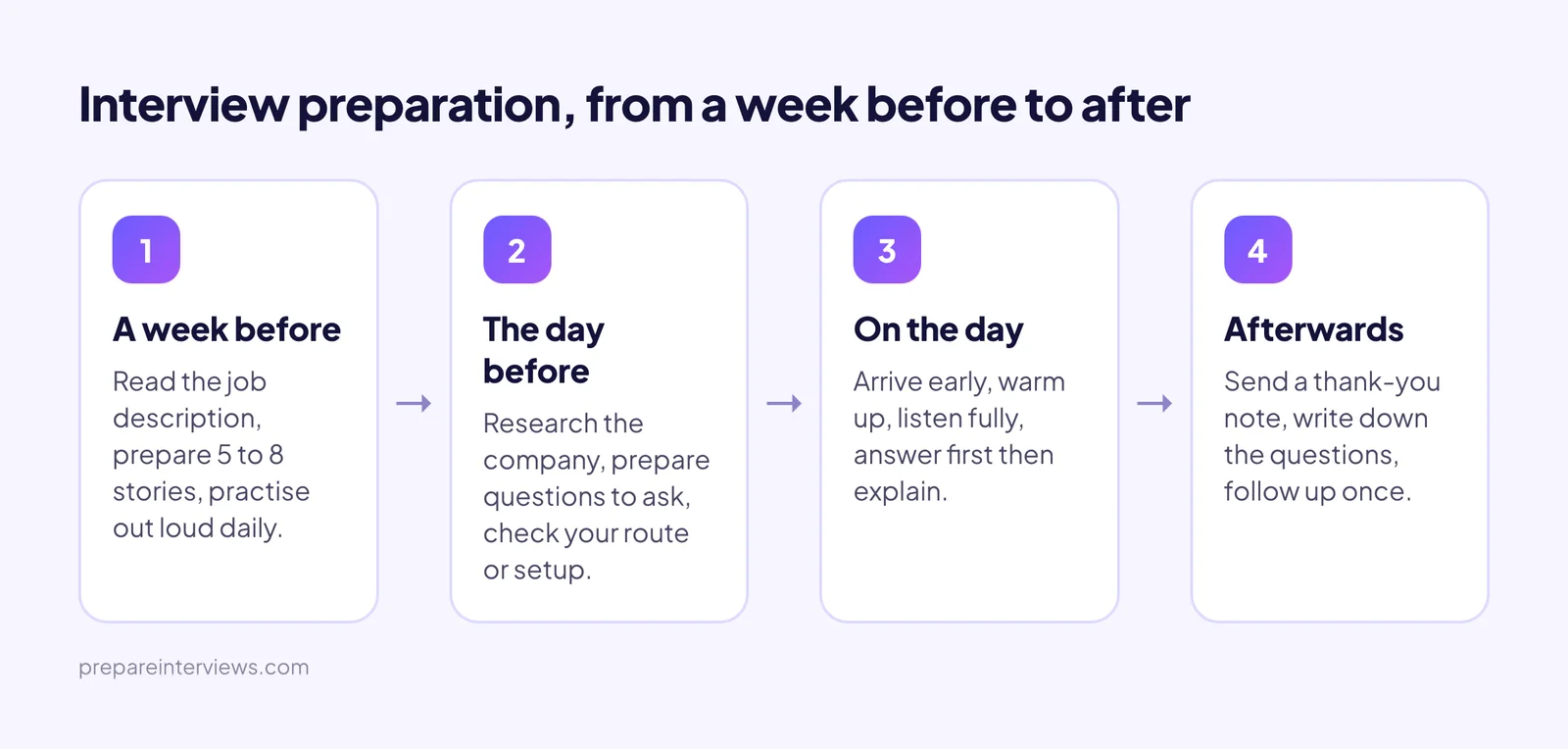
A one-page interview checklist
A week before
- Read the job description and mark the must-haves.
- Prepare five to eight STAR stories.
- Outline answers to the common questions above.
- Start practising out loud on camera, a little each day.
The day before
- Research the company and the interviewer for 15 minutes.
- Prepare two or three questions to ask.
- Plan your route, or test your video setup.
- Lay out your clothes and documents.
On the day
- Arrive early or log in five minutes before.
- Warm up by saying your introduction out loud once.
- Listen fully, pause, answer first and then explain.
Afterwards
- Send a thank-you note.
- Write down the questions you were asked.
- Follow up once if you have not heard back by the date given.
Practise these tips in a real-feeling interview
Tips only help once they become habits, and habits come from repetition. Paste the job description into the free practice room, and a virtual interviewer will ask you questions written for that job — with follow-ups, like a real panel — while you answer on camera. Review each recording, change one thing, and try again. A few short sessions before your interview will do more than any amount of reading.