Campus placements compress a lot into a few days: tests, group discussions and interviews, often with many companies visiting in a short season. Students who do well are rarely the ones who studied the most the night before. They are the ones who prepared steadily for each round, and practised speaking, not only reading.
How campus placements usually work
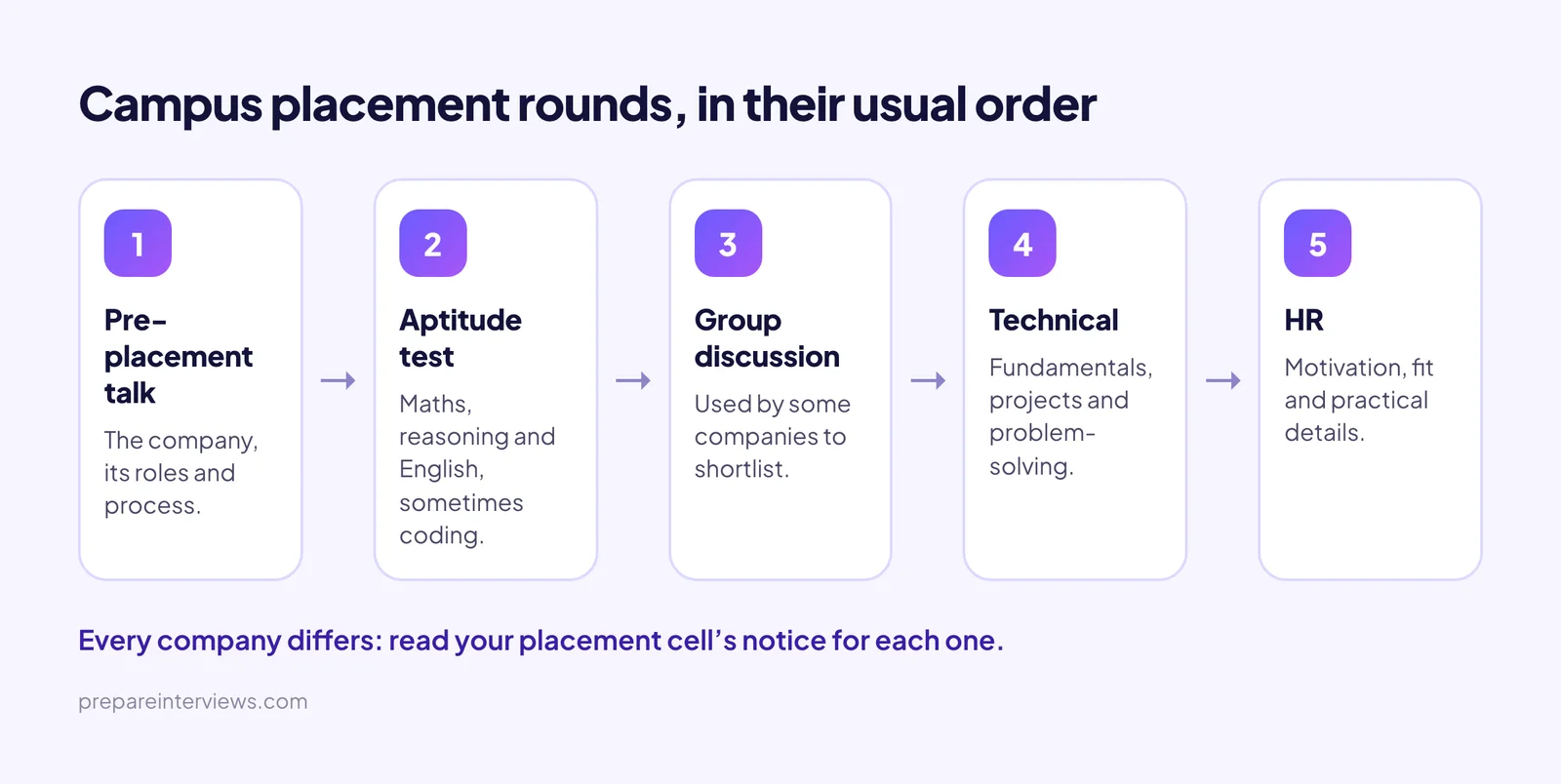
The exact process differs by company and college, but most follow some combination of these rounds:
- Pre-placement talk: the company presents itself, its roles and its process. Attend and take notes; the details help in your HR interview.
- Online assessment or aptitude test: quantitative aptitude, logical reasoning and verbal ability, sometimes with a coding or technical section.
- Group discussion (GD): some companies use it to shortlist; see group discussion tips.
- Technical or functional interview: your subject knowledge, projects and problem-solving.
- HR interview: motivation, fit, communication and practical details.
Mass recruiters may combine rounds; product companies often have more technical rounds. Read your placement cell’s notice for each company carefully.
What each round tests, and how to prepare
Aptitude and online tests
- Tests: speed and accuracy in maths, reasoning and English, under time pressure.
- Prepare: practise timed sections every day. Accuracy first, then speed. Review every mistake.
Group discussion
- Tests: communication, listening, clarity of thought and how you work in a group.
- Prepare: read the news regularly, practise speaking for one minute on a topic, and take part in mock GDs with friends.
Technical or functional interview
- Tests: your fundamentals, your projects and how you think through a problem.
- Prepare: revise core subjects for your branch, be able to explain every project on your resume in detail, and practise explaining your thinking out loud. See the software engineer fresher questions if you are in tech.
HR interview
- Tests: motivation, fit, communication and honesty.
- Prepare: your introduction, your reasons for the company, and stories from college you can use as examples. See the HR interview tips and the fresher interview questions.
A four-week plan
| Week | Focus | Daily habit |
|---|---|---|
| 1 | Resume, introduction, core subject revision | 30 minutes aptitude practice; write your “Tell me about yourself” |
| 2 | Projects in depth; common HR questions | 30 minutes aptitude; explain one project out loud on camera |
| 3 | Mock GDs and mock interviews | 20 minutes news reading; one mock interview every two days |
| 4 | Company-specific preparation; rest before placement days | Review notes for each company; light practice only |
Adjust it to your schedule, but keep the daily habits. Short, regular practice beats long, irregular sessions.
Your resume for placements
- Keep it to one page.
- Put projects and internships near the top, with what you did and any result.
- Only list skills you can discuss in an interview.
- Check every date, name and number. Interviewers often start from your resume.
Mock interviews before placement week
Most students practise aptitude and forget to practise speaking. A mock interview — with a friend, a senior, your placement cell, or the virtual interviewer in our practice room — shows you how your answers actually sound. Record yourself, watch it back, and fix one thing at a time. The fresher interview questions and the HR round sample set are ready to practise.
Off-campus options
If campus placements do not work out, or your college has few companies visiting, off-campus routes are common: company careers pages, hiring challenges, job portals, referrals from seniors and alumni, and internships that convert to jobs. The preparation is the same, so nothing you have done is wasted.
Frequently asked questions
When should I start preparing for placements?
Ideally a few months before placement season begins, with steady daily practice. If you have less time, the four-week plan above covers the essentials.
What if I get rejected in the first few companies?
It is very common. Note what went wrong in each round and adjust. Many students get their offer later in the season.
Do CGPA cut-offs matter?
Many companies set eligibility criteria, including CGPA and backlog rules. Check each company’s criteria in your placement cell’s notice so you know where to focus.
Practise speaking, not only reading
Placement interviews reward students who can explain clearly under a little pressure. Paste a company’s job description into the practice room, and the virtual interviewer will ask questions written for that role while you answer on camera. A few sessions before placement week make the real thing feel familiar. Start with the first job interview tips if this is your first interview.