
Group discussions (GDs) are common in campus placements and MBA admissions in India. Eight to twelve candidates discuss a topic for 10 to 20 minutes while evaluators watch. Many students think the goal is to speak the most. It is not. Evaluators are looking for people who think clearly, add value and work well with others.
How GDs are assessed
Evaluators typically watch for:
- Content: relevant points, examples and facts that move the discussion forward.
- Communication: clear, concise speech at a steady pace.
- Listening: building on what others said, not repeating it.
- Leadership: bringing structure, summarising, or bringing in quieter members.
- Attitude: calm, respectful disagreement; no shouting or interrupting.
Before the GD starts
- You may get a minute or two to think. Jot down three or four points, with one example or fact for each.
- Decide your stance if it is a debate-style topic, but stay open: changing your view with a good reason is a strength.
- Note which side most people are likely to take; a thoughtful counterpoint can stand out.
How to start the discussion
Starting can earn credit, but only if you start well. Good ways to open:
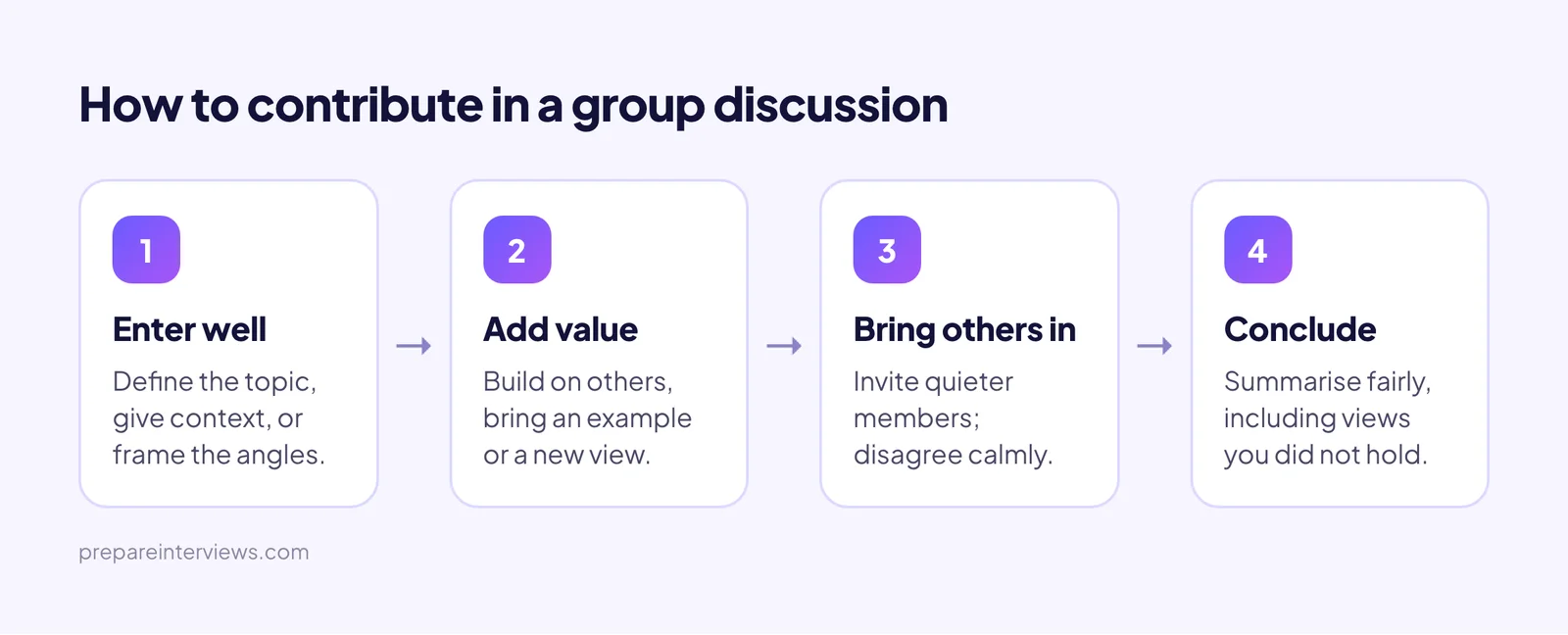
- Define the topic: “Before we discuss whether remote work is good for productivity, it helps to separate fully remote from hybrid work.”
- Give context: a short fact or recent development.
- Frame the discussion: “We could look at this from three angles: employees, companies and cities.”
If you are not confident about the topic, it is better to make a strong second or third point than a weak opening.
How to add value during the discussion
- Build on others: “Adding to what Priya said about costs…” shows listening.
- Bring something new: an example, a fact, or a different stakeholder’s view.
- Keep each point short: 20 to 40 seconds is usually enough.
- Use simple structure: “There are two reasons. First… Second…”
- Bring in quieter members: “We haven’t heard from Arjun yet — what do you think?” This is often noticed by evaluators.
Handling a dominant speaker
Someone usually tries to talk over everyone. Do not shout back. Wait for a pause, enter with a short, polite bridge (“That’s a fair point, and I’d like to add…”), and make a crisp point. If needed, address the group rather than the dominant speaker.
How to conclude
If no one has summarised, offer to: “If I may summarise, we’ve agreed that… and disagreed on… Overall, the group feels that…” A balanced summary that includes views you did not hold shows maturity.
Types of GD topics, with examples
| Type | Examples |
|---|---|
| Current affairs | Is the four-day work week practical in India? · Should social media platforms verify every user? |
| Business and economy | Startups vs established companies for freshers · Is cash still important in a digital economy? |
| Technology | Will AI create more jobs than it removes? · Should children use smartphones before 12? |
| Social issues | Is online education as effective as classroom teaching? · Work-life balance for young professionals |
| Abstract | “Red vs blue” · “Zero” · “The road less travelled” |
| Case-based | A short business situation the group must solve together |
For abstract topics, there is no right answer: pick an interpretation, explain it, and connect it to something concrete.
Mistakes that cost candidates
- Speaking without a point, just to be heard.
- Interrupting, shouting or personal criticism.
- Repeating what others said without adding anything.
- Staying completely silent.
- Quoting numbers you are not sure about. If unsure, say “roughly” or leave the number out.
- Looking only at the evaluators instead of the group.
How to practise
- Read the news for 15 minutes a day and note two or three issues you could discuss.
- Practise speaking for one minute on a random topic, on camera, and watch it back.
- Run mock GDs with five or six friends, with one person observing and giving feedback.
- Practise summarising a discussion in 30 seconds.
Frequently asked questions
Should I start the GD?
Only if you have a clear, relevant opening. A strong point later is better than a weak start.
How many times should I speak?
There is no fixed number. Three or four meaningful contributions in a 15-minute GD is usually better than many small ones.
Can I use Hindi or another language?
Usually GDs are in English unless stated otherwise. If you are unsure, ask the coordinator before it begins.
Practise speaking on camera
A GD rewards short, clear points made under pressure. Practising one-minute answers on camera builds exactly that skill. In the practice room, add GD-style prompts to a set — “Give your view on the four-day work week in one minute” — and the virtual interviewer will ask them aloud while you answer. For the rest of the placement process, see campus placement preparation and the MBA interview questions.