“What are your strengths and weaknesses?” is one of the most common interview questions in India, in HR rounds and managerial rounds alike. Sometimes it comes as one question, sometimes as two. Either way, the interviewer is not looking for a perfect person. They want to see whether you know yourself, whether you can back up what you say, and whether you are honest about what you are still learning.
What the interviewer is checking
- Self-awareness: do you have a realistic view of what you are good at and where you struggle?
- Evidence: can you support a strength with a real example?
- Honesty and growth: will you admit a genuine weakness, and are you doing something about it?
- Fit: does your strength matter for this job, and is your weakness something the job can live with?
How to answer the strengths question
Pick one or two strengths that matter for this job, and prove each with a short example. A strength without evidence is just a claim.
A simple structure:
- Name the strength in a few words.
- Give one specific example where it made a difference.
- Connect it to the role.
One of my strengths is explaining technical things simply. In my internship I was asked to train the sales team on our new CRM, and I made a two-page guide with screenshots instead of a long manual. Most of the team were using it on their own within a week. In a client-facing analyst role like this, I think that matters as much as the analysis itself.
Strengths you can choose from
Choose ones you can genuinely prove:
- Explaining complex ideas simply
- Staying calm and organised under deadlines
- Attention to detail
- Learning new tools quickly
- Building rapport with customers or clients
- Taking ownership and following through
- Working well across teams
- Structured problem-solving
- Writing clearly
- Handling numbers and data
- Persistence on difficult problems
- Organising people and events (useful for freshers with college experience)
How to answer the weaknesses question
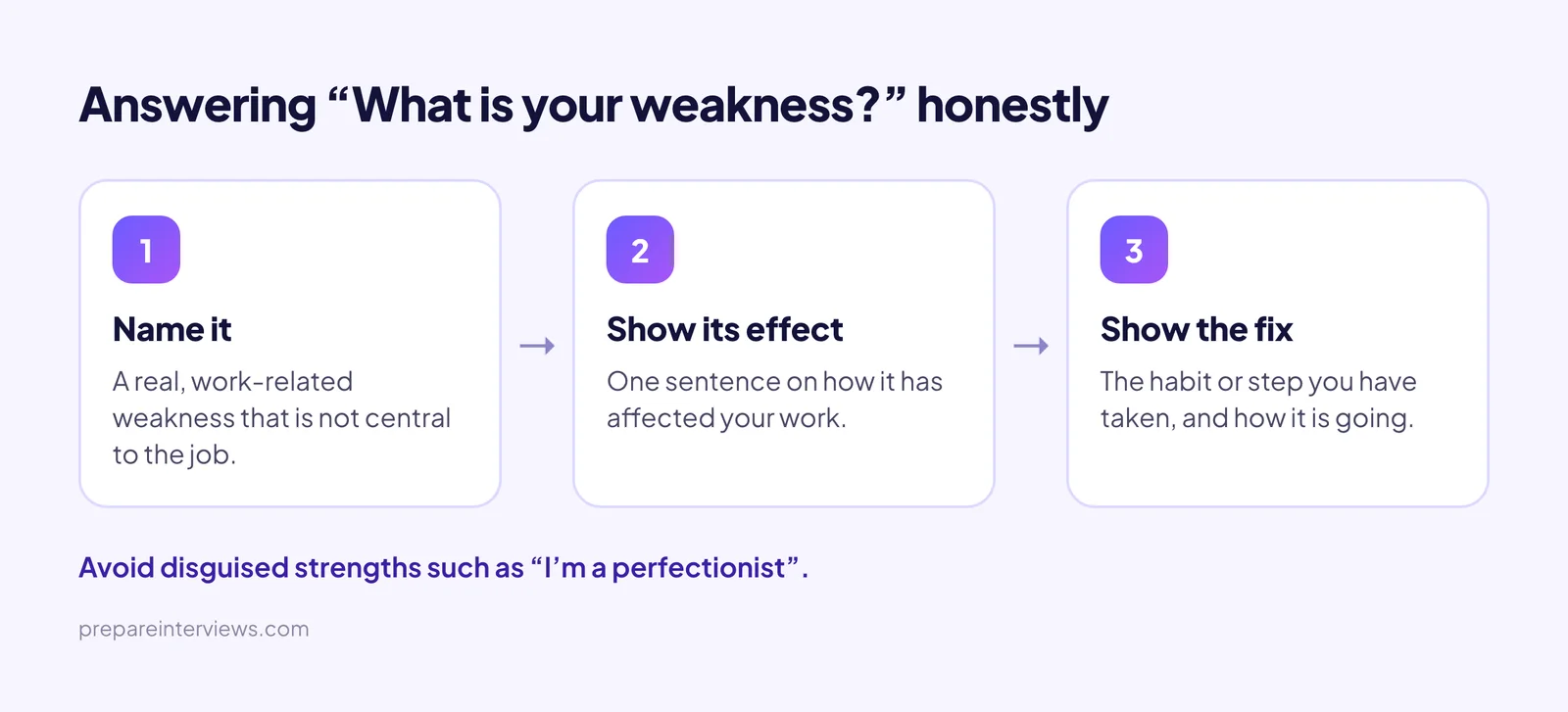
This is the harder half. The rule is simple: name one real weakness, show that you understand its effect, and explain what you are doing about it.
- Name it plainly. A real, work-related weakness that is not central to the job.
- Show its effect. One sentence on how it has affected your work.
- Show what you are doing. The specific habit or step you have taken, and how it is going.
Public speaking hasn’t come naturally to me. In my first year of college I avoided presenting in group projects, and I noticed it was holding me back. So I volunteered to present our team’s final-year project at the department review, and I’ve been practising presentations on video since then. I’m much more comfortable now, though I still prepare more than most people do.
Weaknesses that work, with what to say you are doing
| Weakness | What you are doing about it |
|---|---|
| Public speaking | Volunteering to present; practising on camera |
| Saying yes to too much | Using a task list and agreeing deadlines before accepting work |
| Getting stuck in details | Setting a time limit and checking priorities with your lead |
| Hesitating to ask for help | Asking earlier, after a fixed time spent trying alone |
| Delegating (for experienced hires) | Handing over smaller tasks first, with clear check-ins |
| Limited experience with a tool the job uses | A course you have started, or a small project using it |
| Giving direct feedback | Using a simple structure and practising with peers |
| Over-preparing | Deciding in advance what “ready” looks like |
Pick one that is true for you. A borrowed weakness is easy to see through when the interviewer asks a follow-up question.
Weaknesses to avoid
- Disguised strengths such as “I’m a perfectionist” or “I work too hard.” Interviewers hear these constantly, and they sound evasive.
- Weaknesses central to the job. Do not say “I find numbers difficult” for an accounts role.
- Character problems such as being late, losing your temper or not trusting colleagues.
- “I don’t have any weaknesses.” Everyone has some; this answer suggests a lack of self-awareness.
Sample answer for a fresher (both halves together)
I’d say my main strength is organisation. I was the coordinator for our college tech fest, which meant managing 30 volunteers and a fixed budget across three days, and everything ran on schedule.
A weakness I’m working on is that I sometimes take too long to ask for help. In my internship I spent most of a day stuck on a data problem that my manager solved in ten minutes. Since then I give myself a fixed time to try on my own — about an hour — and then I ask. It has made me much faster.
Frequently asked questions
How many strengths and weaknesses should I mention?
One or two strengths and one weakness are enough. More than that turns into a list, and lists are hard to remember.
Is “perfectionism” a good weakness?
Usually not. It is the most common answer, and most interviewers treat it as a way of avoiding the question. If perfectionism genuinely affects you, describe the specific effect (“I spend too long polishing reports”) and the fix.
What if they ask for three weaknesses?
Prepare two or three real ones in advance, each with what you are doing about it. Keep each to two or three sentences.
Should my weakness be work-related?
Yes. Personal weaknesses that have nothing to do with work do not answer the question and can raise unnecessary doubts.
Practise it out loud
The weakness half is where most people stumble, usually because they have never said it aloud. Add both questions to a set in the practice room, and the virtual interviewer will ask them while you answer on camera. Your strength should use the same evidence as your answer to “Why should we hire you?”, and if you are asked to describe yourself in three words, the words should match too. Consistent answers are convincing answers.