“Why should we hire you?” sounds like an invitation to boast, which is why many candidates either freeze or list adjectives. It is really a request for a short summary: of everything we have discussed, why are you a good fit for this job? A clear, specific answer to this question is one of the most useful things you can prepare. It often comes near the end of an HR or managerial round, and it is one of the common interview questions worth practising out loud.
What the interviewer is really asking
The interviewer wants three things from your answer:
- Do you understand the job? Your answer shows whether you know what the role actually involves.
- Can you do it? They want evidence, not claims.
- Will you add something? Beyond meeting the requirements, what will you bring to this team?
They are not asking you to compare yourself with other candidates, whom you have never met. Talk about yourself and the job.
A three-part answer: match, proof, value
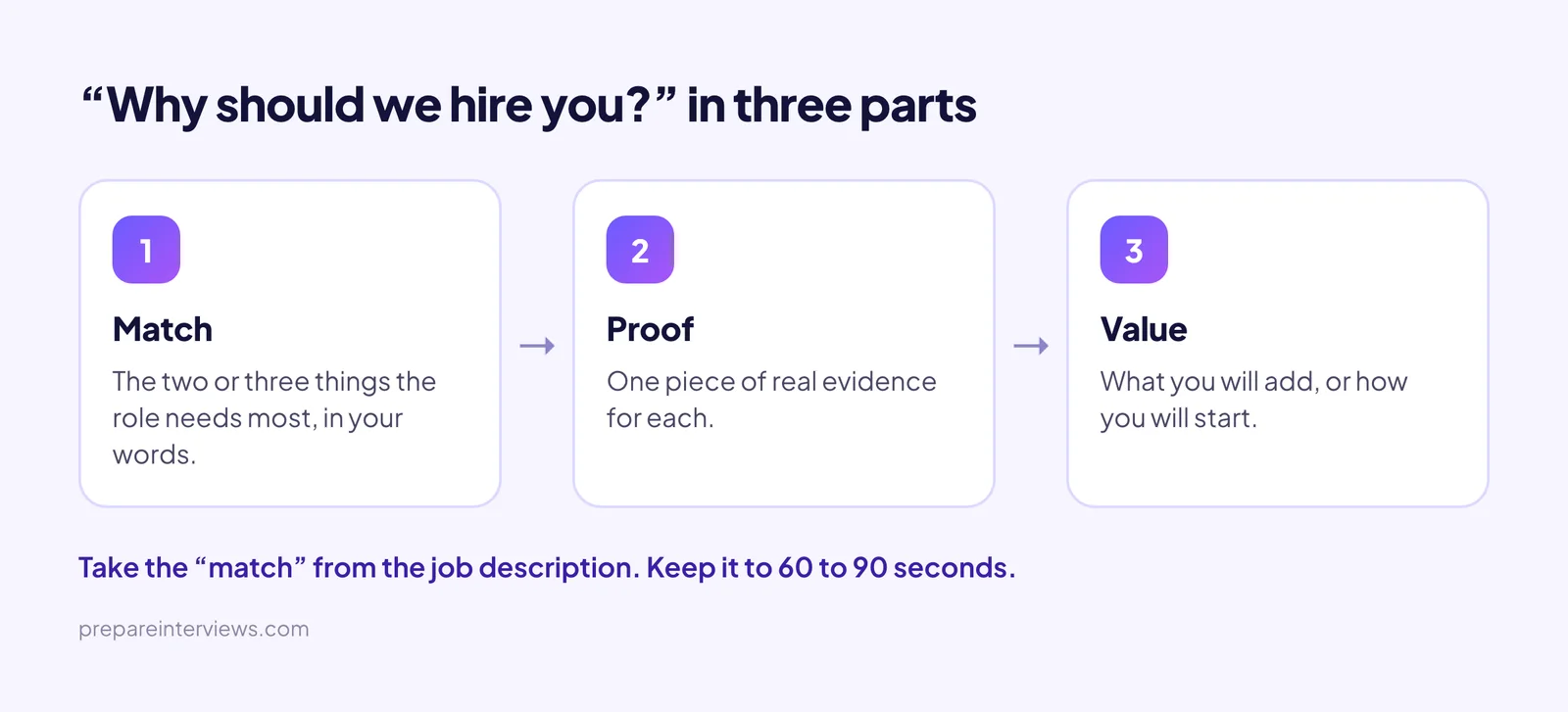
A strong answer usually takes 60 to 90 seconds and has three parts:
- Match — name the two or three things the role needs most, in your own words.
- Proof — for each, give one specific piece of evidence from your experience: a project, an internship task, a result.
- Value — say what you will add or how you will approach the first few months.
Take the “match” from the job description. If it mentions SQL and stakeholder reporting twice, those are your two points. If it stresses customer handling, lead with that.
Sample answer: a fresher
From what you’ve described, this analyst role needs someone who is comfortable with data, careful with details, and able to explain numbers to people who aren’t analysts.
In my final-year project I cleaned and analysed two years of sales data for a local distributor using Excel and SQL, and the owner now uses the dashboard I built every week. During my internship I prepared the weekly report for the operations manager, which taught me to check every figure twice and to explain what changed and why.
I’m early in my career, but I learn quickly and I enjoy this kind of work. I’d bring that care and curiosity from day one, and I’m keen to learn from your team’s experience.
It is specific, it links each claim to evidence, and it is honest about being a fresher without apologising.
Sample answer: an experienced candidate
This role is about growing the B2B accounts in the western region and building a small team to do it.
Over the last four years at my current company I’ve managed around 40 business accounts, and I grew revenue in my portfolio each year by focusing on the accounts with the most room to expand. I also trained the two newest members of the team, which is the part of the job I’ve enjoyed most.
I’d bring an approach that already works in a similar market, plus the experience of bringing new people up to speed quickly — which sounds like exactly what you need as the team grows.
Notice that the numbers are the candidate’s own. Use real figures from your work, and only figures you can explain if asked.
Sample answer: a career changer
You’re looking for someone who can design clear training material and work with subject experts to get it right.
I taught mathematics for six years, so explaining difficult ideas simply is what I’ve done every day. Over the past year I completed a course in instructional design and built three short online modules for my school, which other teachers now use.
I’d bring a teacher’s instinct for where learners get stuck, and I’m ready to learn the tools and processes your team uses.
Career changers should name the change and connect their past directly to the new role, rather than hoping the interviewer will make the connection.
Mistakes that make it sound rehearsed
- A list of adjectives. “I am hard-working, passionate and a team player” could be said by anyone. Replace each adjective with a piece of evidence.
- Repeating your resume. The interviewer has it. Pick only what matters for this job.
- Talking about what you want. “This job will help me grow” answers a different question. Keep the focus on what you offer.
- Going on too long. Past two minutes, the point gets lost. Three parts, one piece of evidence each, then stop.
- Overclaiming. “I’m the best candidate you’ll meet” invites scepticism. Confidence comes from specifics, not superlatives.
- Reciting word for word. A memorised answer sounds flat and falls apart if the question is phrased differently (“What makes you a good fit?”). Learn the three points, not the sentences.
How to prepare your own answer
- Read the job description and write down the two or three things it needs most.
- Under each, write one piece of evidence from your own experience.
- Write one sentence about what you would add.
- Say it out loud, on camera, and time it. If it runs past 90 seconds, cut.
- Practise it with different wording: “What makes you a good fit?”, “What can you bring to this role?”, “Why are you the right person for this job?”
The STAR method helps if a piece of evidence needs to be told as a short story, and your strengths and weaknesses answer should use the same evidence, so your answers support each other.
Frequently asked questions
How long should my answer be?
About 60 to 90 seconds — roughly 150 to 220 spoken words. That is long enough for three pieces of evidence and short enough to hold attention.
Can I say I am a fast learner?
Yes, if you prove it. “I learned Power BI in two weeks for my internship project and built the team’s first dashboard” is believable. “I am a fast learner” on its own is not.
What if I do not meet every requirement?
Lead with the requirements you do meet, and address the gap briefly and honestly: what you have done that is close, and how you would close the gap. Interviewers rarely expect a perfect match.
Should I compare myself with other candidates?
No. You do not know who else applied. Focus on how well you fit the job, not on how you rank against people you have never met.
Is this the same as “Tell me about yourself”?
They overlap, but “Tell me about yourself” is a short introduction, and “Why should we hire you?” is a closing argument for this specific job. See how to answer “Tell me about yourself”.
Practise it with the virtual interviewer
This question is easy to understand and surprisingly hard to say well the first time. Add “Why should we hire you?” to a question set in the practice room, and the virtual interviewer will ask it aloud while you answer on camera. Record it three times: once unprepared, once with your three points written down, and once more under 90 seconds. Watch the last one back — that is the version to take into the interview.