“What is your current CTC, and what is your expected CTC?” comes up in almost every HR round in India. It is a practical question, not a test, but an unprepared answer can cost you money or the offer. This guide explains what CTC means, how to work out a fair expectation, and what to say.
Current CTC and expected CTC: what they mean
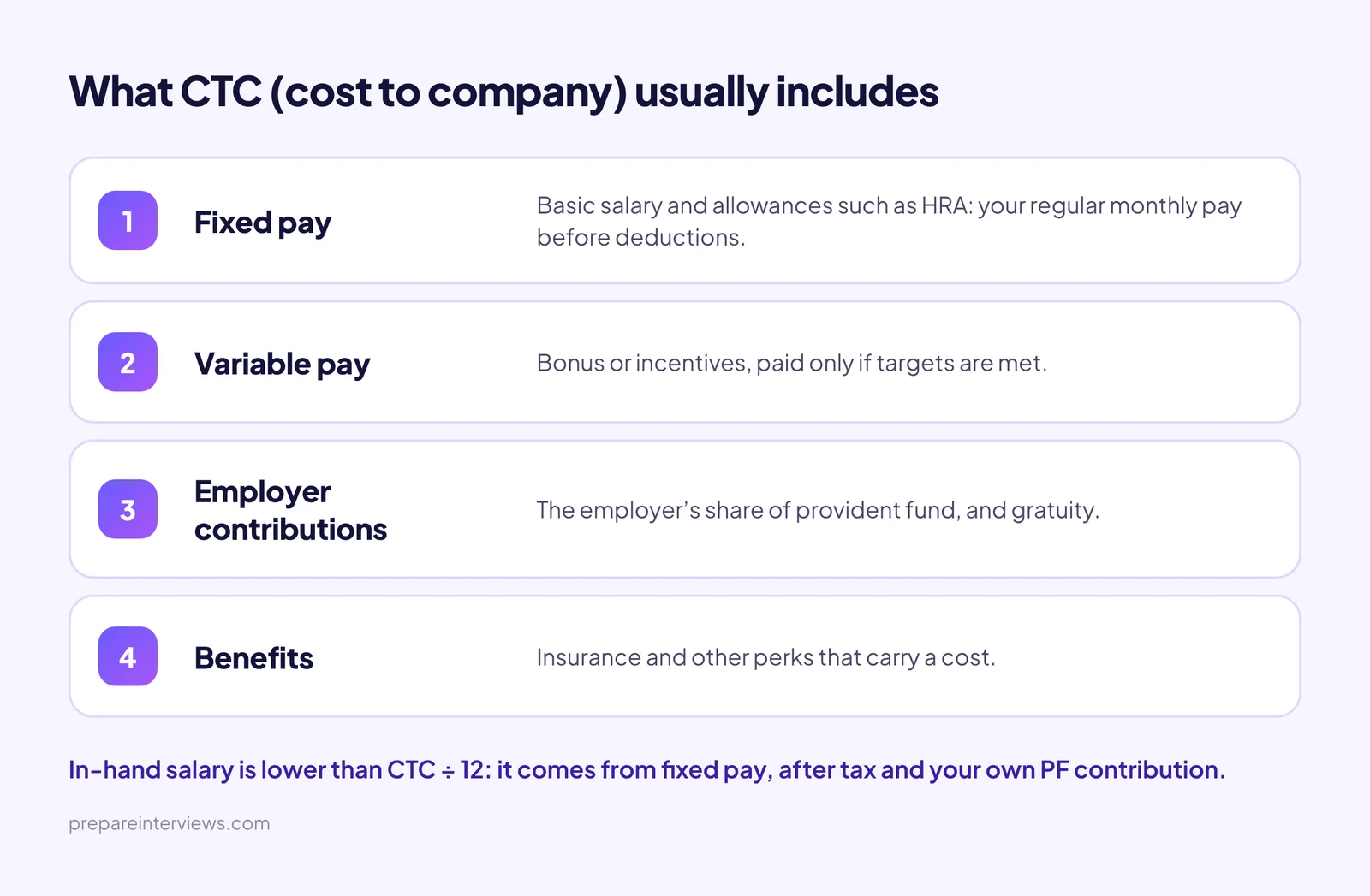
CTC (cost to company) is the total amount an employer spends on you in a year. It is usually more than the salary you receive each month, because it includes several parts:
| Part of CTC | What it usually means |
|---|---|
| Fixed pay | Basic salary, allowances such as HRA — the regular monthly amount before deductions |
| Variable pay | Performance bonus or incentives, paid only if targets are met |
| Employer contributions | Employer’s share of provident fund (PF), and gratuity |
| Benefits | Insurance, meal cards, and other perks that carry a cost |
| One-time payments | Joining bonus or retention bonus, sometimes shown separately |
Current CTC is your total package now. Expected CTC is the total package you are asking for in the new role.
Two practical points:
- Know your current CTC and its breakdown — fixed and variable at least. Your offer letter or salary structure has these details.
- When you compare offers, compare fixed pay as well as CTC. Two offers with the same CTC can pay very different monthly amounts.
How to work out a fair expected CTC
Before the interview, find a realistic range for this role, in this city, at your level of experience:
- Job postings that state a salary range for similar roles.
- Salary research sites such as AmbitionBox, Glassdoor and Naukri, which show reported salaries by company and role. Treat these as rough guides: they are self-reported and vary in accuracy.
- People in the field: seniors, college alumni or friends in similar roles.
- Your own value: specific skills, certifications or results that put you at the higher end.
Then set three numbers privately: the figure you would be happy with, the range you will state, and the lowest number you would accept.
What to say: scripts that work
For freshers
Freshers usually join at the company’s standard fresher package, especially in campus hiring. A good answer:
As a fresher, my main focus is on learning and doing good work. I understand you have a standard package for this role, and I’m comfortable with that. If there’s flexibility, I’d appreciate it being in line with the industry range for this role.
If you have a specific skill or internship experience, you can mention it briefly as a reason for the higher end.
For job switchers
Give a range, based on research, with a short reason:
My current CTC is 6.5 lakh, of which 5.8 is fixed. Based on the responsibilities of this role and what I’ve seen for similar roles in Bengaluru, I’m looking for something in the range of 8 to 9 lakh. I’m open to discussing the structure.
The numbers here are only an example. Use your own figures and your own research.
If you are moving into a bigger role or a new field
This role has more responsibility than my current one, including managing a small team, so I’m looking at the market range for that level, which I understand is around X to Y. I’m flexible on the structure if the overall package reflects the role.
When they push for one number
Sometimes HR asks for a single figure. Give the number near the middle-to-upper part of your range, and keep it calm:
If I had to give one number, it would be around 8.5 lakh, but I’m open to discussing the overall package.
Questions to expect, and honest answers
- “Why is your expectation so much higher than your current CTC?” Explain with facts: a bigger role, a skill you bring, or that your current pay is below the market range for your experience.
- “Is your expected CTC negotiable?” Yes, within reason. Say what matters to you — for example, fixed pay over variable.
- “Can you share your payslips?” Many employers ask for these. This is why your stated current CTC must be accurate.
What not to do
- Do not inflate your current CTC. Many companies verify it with payslips or bank statements, and a mismatch can lead to the offer being withdrawn.
- Do not give a number without research. Too low and you may lose money for years; too high and you may lose the offer.
- Do not negotiate aggressively in the first round. State your range calmly. The real negotiation usually happens once there is an offer.
- Do not ignore the breakdown. A higher CTC with a large variable component may pay less each month.
Negotiating after the offer
Once you have an offer in writing, you have the most room to negotiate. Thank them, ask for the breakdown if you do not have it, and if it is below your range, say so with your reason. Ask about the joining date and notice period at the same time.
Frequently asked questions
What is a normal hike when switching jobs?
It varies widely by industry, role, city and demand for your skills, so there is no single “normal” number. Base your range on what the new role pays in the market, not only on a percentage over your current CTC.
Should I tell my current CTC if I am underpaid?
Be honest about it, and then explain why your expectation is based on the market and the role rather than on your current pay.
Is CTC the same as in-hand salary?
No. In-hand salary is what reaches your bank account each month, after deductions such as tax and your PF contribution. It is lower than CTC divided by twelve.
Practise saying the numbers
Talking about money out loud makes most people uncomfortable, and that discomfort shows. Add “What is your expected CTC?” to a set in the practice room and let the virtual interviewer ask it while you answer on camera. Practise until you can say your range in one calm breath. The HR interview tips and the HR interview questions cover the rest of the round.